There have been many different art movements in the history of the world. There were a specific two that were particularly influential to literature. They also contrasted each in as opposite ways as is possible in the art world.
Aestheticism
What is Aestheticism? In the dictionary aestheticism is defined simply as: “Devotion to and pursuit of the beautiful; sensitivity to artistic beauty and refined taste.” The overarching idea of aestheticism is “Art for Art’s Sake.” Aestheticism is the art movement that was founded off of the idea that art should be for beauty not for any other purpose. In aesthetic art there are often many colors used that work well with each other. Many aesthetic art pieces were extremely detailed and usually were very realistic. Their sole purpose is to be pretty to the viewers’ eyes instead of a way to express a social or political idea or theme.
Take a look at this painting for example. This is The Garland: A Girl Tending Flowers by Edward Burne Jones.

If you look at this aesthetic piece of art you will see how it is extremely detailed. Yet at the same time it was painted for beauty, not to sponsor a political party, political campaign, or any social class. This painting just is. This is the idea of aestheticism, the art just is.
Aestheticism in Literature
Aestheticism doesn’t just apply to art that is in the form of paintings and sculptures; it also applies to art in the written form, literature. Oscar Wilde (the author of The Importance of Being Earnest) was a figurehead for the aesthetic movement. He had long hair, wore many colors, and carried flowers during lectures. This was extremely unacceptable at the time. He was a revolutionary in the art world because he wrote literature that was beautiful not purposeful. If we look at his work The Importance of Being Earnest, we see that it has a lot of aesthetic qualities and parts. Yet at the same time it is not a completely aesthetic work. Although it incorporates many aesthetic ideas and individual parts, it has a purpose. It does not wholly fit the “art for art’s sake” ideal because the play is used to make fun of and criticize the aristocracy of the Victorian era. Yet Oscar Wilde did not write it to make money, or propagate any ideas. He wrote it to entertain the audience. This is what makes it an aesthetic play.
Suprematism
Suprematism is “a school and theory of geometric abstract art that originated in Russia in the early 20th century and influenced constructivism.” Suprematism focuses on geometric shapes, especially the square and circle. Many paintings were as simple as geometric shapes in a painting, but more complex pictures put those shapes together to make people like in Kasimir Malevich’s To the Harvest.
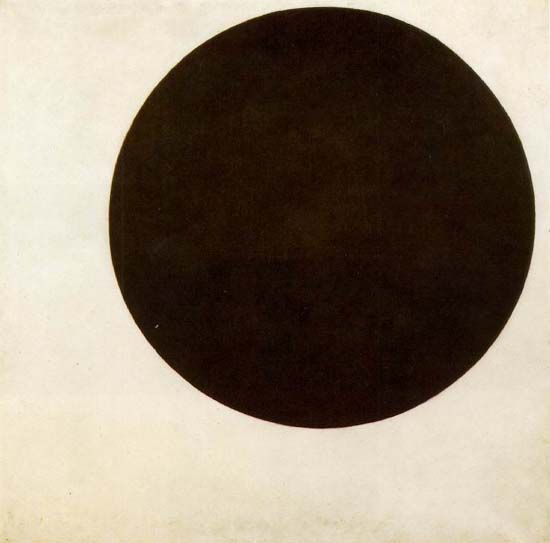 Malevich’s painting Black Circle perfectly shows how suprematism paintings looked. It was simple, yet at the same time it symbolized a lot. The shapes are so basic that they seem to symbolize a new beginning.
Suprematism also did not try to promote social or political ideas; instead it was in a sense “art for art’s sake.” Yet in the Suprematism, it was the simplicity of the art that made it exist for its own sake. In aestheticism, it was the beauty of the art that made it exist for its own sake.
Comparing Two Unlike Paintings
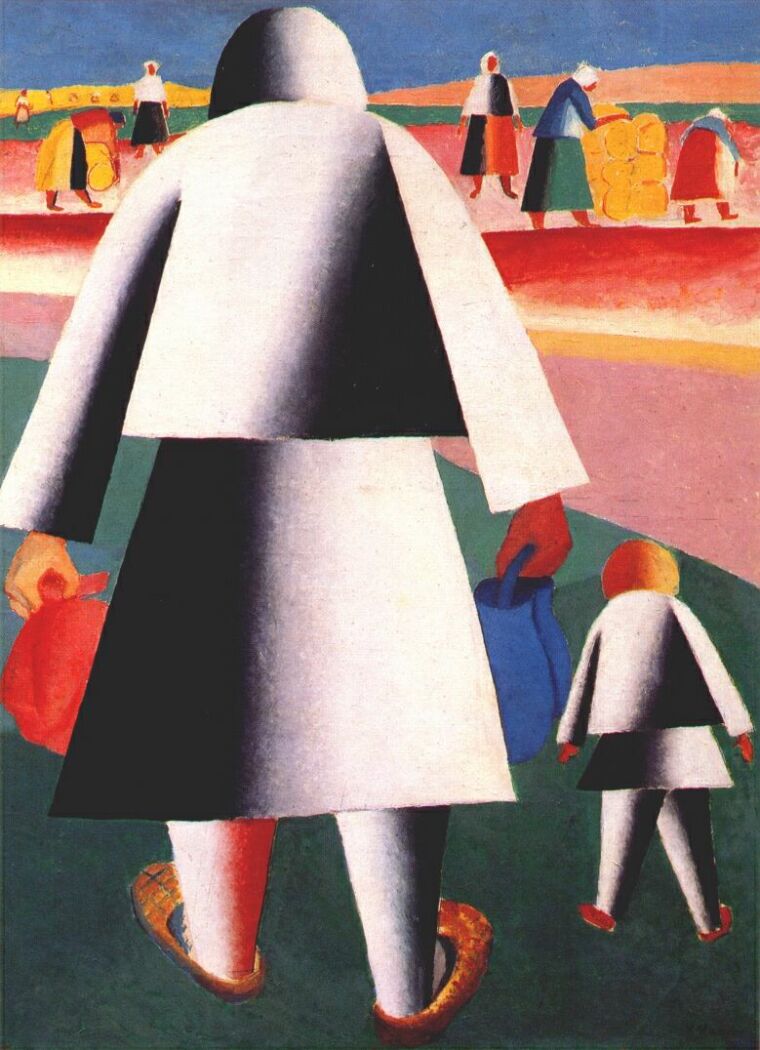 | 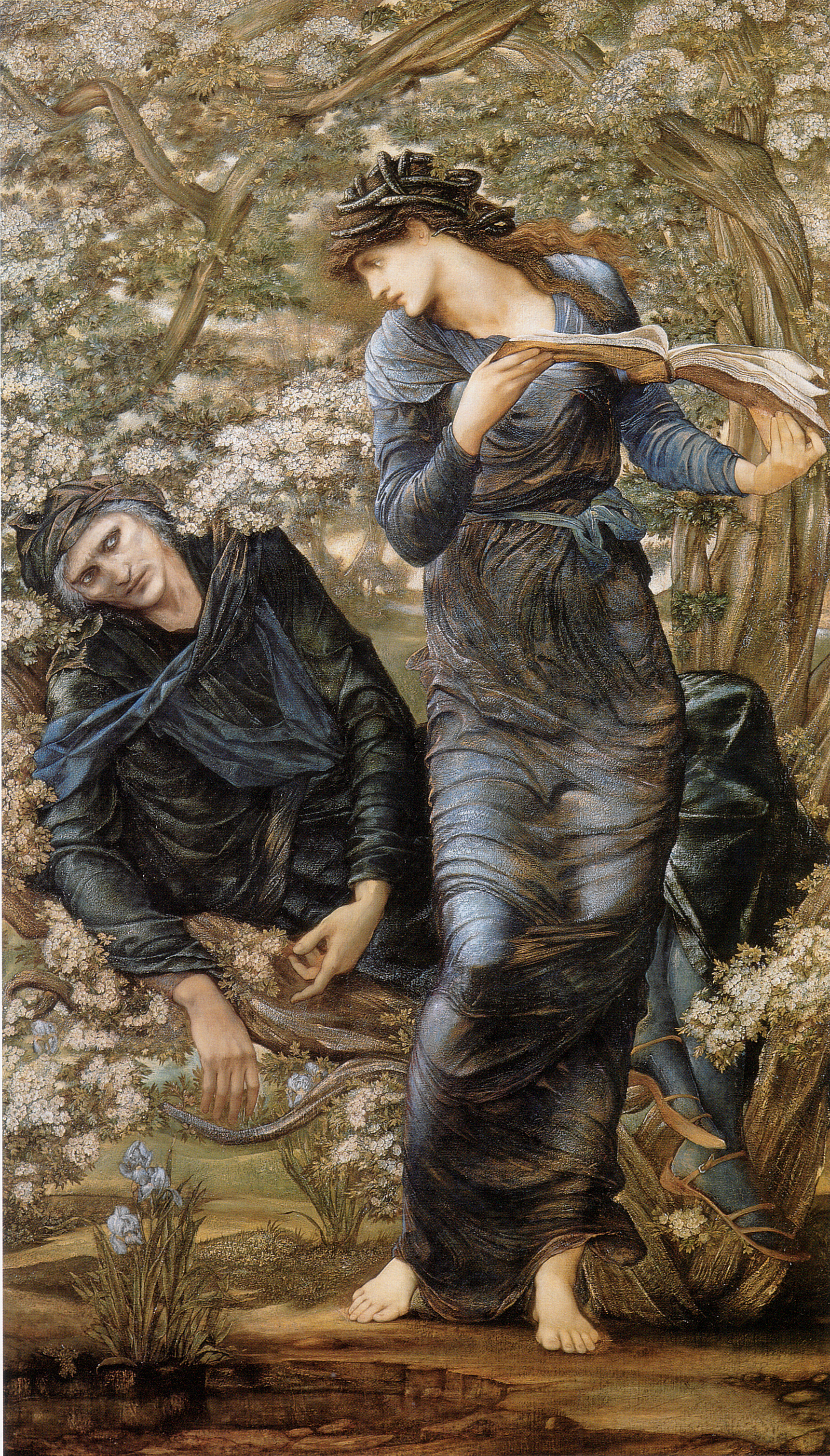 |
To the Harvest | The Beguiling of Merlin |
Painted by: Kasimir Malevich | Painted by: Edward Burne Jones |
Comparison
At first it seems like there is absolutely nothing similar in these two paintings. It seems as if they are on the opposite sides of the spectrum of art. This is the first similarity, they are both art. It may not seem like a big similarity, but a piece of art is made to tell a story or show beauty. These both do both of these things. Both of them tell a story whether it is related to the common people or King Arthur, both paintings tell a story. They both show what their painters considered beauty. Kasimir Malevich painted To the Harvest using shapes to show the beauty in simplicity of life. The Beguiling of Merlin on the other hand shows Edward Burne Jones’ incredible detail in his painting that he uses to show the beauty of life. Both painters did not use the painting to promote any political or social ideas.
Contrast
The most obvious difference between these two paintings is the amount of detail that the painters used. Kasimir Malevich used simple shapes to make his painting, whereas Edward Burne Jones put as much detail as he possibly could into his painting. Kasimir Malevich purposefully made his painting this simple looking, because he was showing the beauty of how simple basic things make-up our world. Edward Burne Jones on the other hand was trying to show the beauty of life and the world with all of his detail. Also the stories that these paintings tell is very different. To the Harvest is a story of the common people, while The Beguiling of Merlin illustrates a part of the legend of Arthur.

Suprematism: A Reaction to Aestheticism

Suprematism was in fact a direct reaction to aestheticism. How is it a reaction? During the 19th century, aestheticism was at its peak. It was all about the beauty of life, but it was about the extravagance of life too. All of the minute details we see in paintings from the aesthetic movement show the love of extravagance and luxuries of the people of the Victorian era. When the Suprematists’ artwork started becoming produced in the early 20th century, it was completely different. The Suprematists believed that the extravagance and over-indulgence of the Victorian era did not represent life and art. The Suprematists believed that our world could be represented with the most basic and simple of shapes. The Suprematists reacted to the aesthetics’ extraordinarily detailed works with simple shapes and simple colors. Using basic shapes the Suprematists showed that they too could represent the world that surrounded them in ways that the aesthetics never could. The Suprematists showed that you can do so much with so little, a concept the aesthetics never understood. The Suprematists showed the world in a way that they believed the aesthetics never captured, in a simple way.
Aestheticism: A Reaction to Victorian Morality/Hypocrisy
Aestheticism took place during the Victorian era. This was an era in which people had to be proper, decent, respectable, and refined. During this era all that mattered to the upper class was their social status. This is what aestheticism is reacting to. Aestheticism is a way of the artists to be able to show that all that the others hold dear, their social rank, is not actually important in the real world. They showed that luxuries were fine, using the incredible amounts of detail. Yet, their art showed that there is beauty in life. The art showed that there is more to life than just social class. They were trying to get at the idea that if the people would pause for a moment in their lives and look at the beauty that is all around them instead of worrying about their social class, they would appreciate their own lives much more.
Sam, I must say that I kind of got lost in your post. There is so much there and I just read the same line over and over and over and over and over again till I realize that I've been hypnotized and I should take an intermission. What I was able to read and not get lost in was really good and is better than it has a right to be for a first post.
ReplyDeleteThank you Jimmy. It's very nice of you to say so. I hope your hypnosis doesn't cause you any long-term problems.
ReplyDeleteMost of this is good, but I think your statement about suprematism not commenting on politics or social structure is incorrect, we had a seminar on how The Harvest commented on communism in Russia, which is definitely a political/social issue. Also, Shostakovich was a suprematist in the musical sense of the word, in that his music was written to communicate very solid message, and generally a painful one, and he was always commenting on politics. I also think that suprematism was about meaning, not simplicity. I don't think the dictionary definitions really capture the essence of the artistic movements. Suprematists may have used simplicity and geometric figures to communicate their messages, but their primary goal was to send messages, not to demonstrate simplicity.
ReplyDeleteI agree with Jimmy. There was so much there and some of it didn't have to do with the comparing and contrasting of the two types of art. But what was about that was really good and made perfect sense.
ReplyDeleteI like your insight Liam, but I still feel that Suprematism does not comment on social structure. The Suprematists used simple shapes to create their art, this fact we can agree upon. Yet at the same time we disagree on the meanings of the paintings themselves. I would like to reference the Black Circle Kasimir Malevich painted. This used the very simple shape, the circle, to capture a single, simple idea. This idea was that there is a new beginning. One could argue that it was to show the blackness of the future at that point in time (referring to the Russian Revolution), but the Russian Revolution had not started at this point in time. The Black Circle was painted in 1913, whereas the Russian Revolution started in 1917. The movement had four good years without any problems with communism. Even once the Revolution did start, the artists still had time to paint before Stalin and his Stalinism took control of Russia and Russian art in 1924. The era of Stalin limiting the art (and requiring artists to not do Suprematism paintings) that could be produced. In a nutshell the Suprematist movement started around 1913, but was a short lived movement and died out around the time Stalin actually came to power because he required the art community to not do that form of art. I do have to say that Shostakovich was a Suprematist. Yet he is not like the others. He is kind of like the Importance of Being Earnest by Oscar Wilde. Wilde wrote the play, but it was not fully Aesthetic. It is the same with Shostakovich. He writes many pieces of music using basic elements and putting them together. Yet his music does have a very important theme (against Stalin). I do agree that the dictionary definition does not fit an artistic style, but the Suprematists did try to show the beauty of simpleness.
ReplyDeleteThank you Sophia, it's very kind of you to say that. My point was that I wanted to define the art movements before I talked about them. I will try to keep it more to the point.
ReplyDelete